A New Kind of Resolution
Decades ago, when we were young and eager for success, my friends and I challenged each other to set the most unachievable New Year’s Resolutions and actually attempt to achieve them.
Patti, a fledgling singer/songwriter, vowed to write a Billboard top-ten hit.
Greg, an early adapter of the fitness industry, promised to create a yoga center for the stars.
Leslie, Chuck, and Vince set excessive salary goals for their next job searches.
And I’d be spending my days huddled over the typewriter, pecking out NYT best-sellers one after the other.
You probably guffawed your way through that list, even if you had similar resolutions of your own back in the day. According to Forbes, 80% of people abandon their resolutions by February—so why should this year be any different?
Maybe the issue isn’t the challenge of “keeping” a resolution.
Maybe the issue is the type of resolution we set.
John Lennon famously wrote, “Life is what happens when you’re busy making other plans,” which should give all of us cause to consider whether we want to spend our days focused on the future, or being “in the now.”
These last few years—dealing with COVID restrictions, political unrest, and the general ups and downs of daily life—I’ve had some time to give that quote and a few others some thought. Maybe attempting to regulate how I behave or what I consume is of less importance than some other things.
Meister Eckhart, the 13th Century German philosopher, said, “Be willing to be a beginner every single morning.”
Wow.
What if, instead of barreling into the day intent on accomplishing as much as possible in the shortest amount of time, we decided to slow down, and let each experience of the day come at us as something new? What if we asked ourselves, “How would a total stranger view this situation, and might that make a different for me today?”
I am quite clear that this is no easy task, and it flies in the face of what many of us have been taught all our lives. But what if asking What if? opened up new possibilities for us or those around us?
Maybe instead of a New Year’s Resolution to be or do more, we should make a resolution to do or be less. “Today I won’t respond to anything without first considering the opposite approach to the one I held yesterday. Today I will play a mind game with myself.”
That could be far more interesting and life-changing than “Today I will do 10 more reps of each exercise,” or “Today I will cut my calorie intake by 10%.”
The quote that got me thinking the most is this: “Every year you make a resolution to change yourself. This year, make a resolution to BE yourself.” (author unknown).
It’s not easy to be yourself, surrounded as we are by hundreds of marketing messages for products, and the constant pressure to conform to fashion in looks and behaviors.
It’s not easy to be yourself.
But what if you gave it a try?
Even if it’s just till February first.
 The zen teachers say the way to enlightenment is to “chop wood and carry water.” I’ve given this considerable thought over the last months, and I’ve come to understand something:
 We call the bad things, the dysfunctional things “lemons.” We say, “When life hands you lemons, make lemonade,” meaning throw a bag of sugar over it so you don’t see the dysfunction, the mechanical failures, the sourness of your situation.
 Having one of those days, darling? You know what I mean – one of those frustrating, exhausting days in which everything you had planned is blown out the window by the things you didn’t anticipate?
 1) Focus on the Goal of your Blog. Is your intent simply to keep your name Top of Mind with your customers and prospects? Are you focused on Lead Generation, website traffic, or building your reputation as an information hub?
 2) Remember What Drew You to Your Industry. Way back when, on the day you started your company or made the decision to take a job in your current industry, you were excited about it. There was something that thrilled you, that satisfied you beyond just the paycheck. What was it? What emotion did it trigger? Find that energy again, and write from that place. It might be helpful to create a list of the reasons you started and the dreams you had about your career.
 3) Tell stories. Stories pull the reader into an experience, and the more they see themselves in that experience, the more willing they will be to keep reading and remember you when they need your product or service.
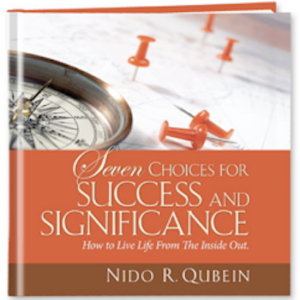 The author, Dr. Nido R. Qubein, came to the United States from the Middle East when he was 17, with just $50 to his name and little knowledge of the English language. Today, he is the President of High Point University in North Carolina, and Chairman of the Great Harvest Bread Company, with 225 stores in 43 states.